
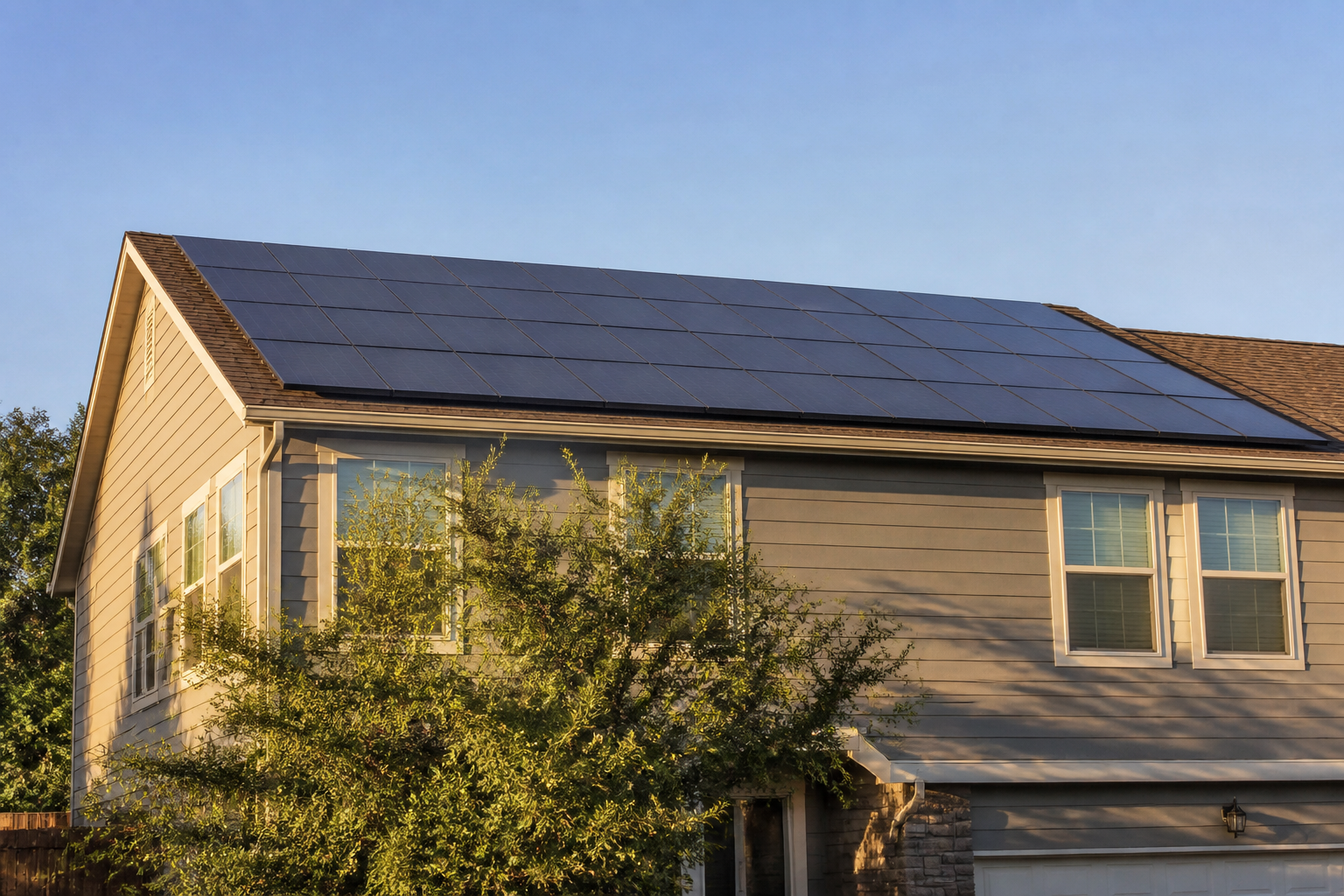
Solar panels turn sunlight into electricity through a process called the photovoltaic effect. Here's the short version: photons from the sun knock electrons loose inside silicon cells, those electrons flow as direct current (DC), and an inverter converts that DC into the alternating current (AC) your house actually uses. A typical residential panel today produces 350 to 450 watts under standard test conditions, and a standard 6 kW rooftop system generates roughly 7,200 to 9,000 kWh per year in most of the US, enough to cover 70, 100% of an average household's usage.
Why does any of this matter? Because understanding how solar panels work changes how you evaluate quotes. Efficiency ratings (usually 19, 22% for mainstream panels), degradation rates (around 0.5% per year), and inverter type directly affect what you'll actually save. Skip the sales gloss and the numbers do the talking, which is the point of this guide.
What Is how solar panels work?
Solar panels turn sunlight into electricity through the photovoltaic (PV) effect. Here's the short version: photons hit a semiconductor (almost always silicon), knock electrons loose, and an electric field inside the cell pushes those electrons in one direction. That directional flow is direct current (DC).
A single silicon cell produces around 0.5 to 0.6 volts. Panels wire 60 to 72 cells in series, which is why a standard residential panel outputs roughly 30, 40 volts and 350, 450 watts under lab conditions (1,000 W/m² of sunlight, 25°C, called Standard Test Conditions).
The scope goes beyond the panel itself. A working system needs four things:
- PV modules, the panels on the roof or ground mount.
- Inverter, converts DC into the 120/240V alternating current (AC) your house and grid use. String inverters, microinverters, and DC optimizers are the three common flavors.
- Racking and wiring, the mechanical and electrical backbone.
- Meter and disconnects, how the utility tracks export and how first responders shut it down.
Real-world output is lower than nameplate. Expect a derate of 15, 25% once you factor in heat (silicon loses about 0.3, 0.5% per °C above 25°C), inverter losses (~2, 4%), wiring, soiling, and shading. A 400W panel in a typical U.S. climate produces about 500, 650 kWh per year.
Context matters too. Solar works on cloudy days (at 10, 25% of clear-sky output), doesn't need direct summer sun to be economic, and pairs with batteries only if your goal is backup or time-of-use arbitrage, not raw payback.
Key Benefits of how solar panels work

The mechanics are simple: photons hit silicon cells, knock electrons loose, and an inverter converts the resulting DC current into usable AC power. That basic physics delivers a handful of concrete benefits worth measuring.
Lower electricity bills. The average U.S. household pays around $1,800 a year for grid power. A properly sized rooftop system offsets 70, 100% of that, depending on roof orientation and local sun hours. Payback periods currently sit between 6 and 10 years in most states, with panels warrantied for 25.
Predictable energy costs. Grid rates have climbed roughly 4% annually over the past decade. Once panels are paid off, your generation cost is effectively fixed. You're hedging against rate hikes for 25+ years using hardware that has no moving parts and needs almost no maintenance.
Modularity. Unlike a gas plant or a nuclear reactor, solar scales down cleanly. A single 400-watt panel works the same way as a 400-megawatt farm, same cells, same physics. That's why the same technology powers calculators, satellites, and utility installations.
Daytime production alignment. Panels generate most between 10 a.m. and 4 p.m., which overlaps with commercial cooling loads and afternoon demand peaks. Even without batteries, that timing reduces strain on the grid when it's under the most stress.
Emissions math. A 6 kW residential system offsets roughly 6, 8 tons of CO2 annually, equivalent to taking about 1.5 cars off the road. Manufacturing emissions are typically recouped within 1, 3 years of operation.
Land-use efficiency. Rooftop solar uses space that's already built. No new footprint, no transmission losses over long distances, and no fuel supply chain. Power is generated where it's consumed, which is something few other energy sources can claim.
How Solar Panels Work

A solar panel is a stack of physics tricks that turns photons into usable electricity. Here's the sequence, step by step.
1. Sunlight hits the panel. A standard 400W residential panel contains around 60-72 silicon cells under tempered glass. On a clear day, roughly 1,000 watts of solar energy strike each square meter of panel surface.
2. Photons knock electrons loose. Each silicon cell has two layers: an upper layer doped with phosphorus (extra electrons, negative charge) and a lower layer doped with boron (electron "holes," positive charge). Where they meet, a permanent electric field forms, the p-n junction. When a photon with enough energy (about 1.1 electron volts for silicon) hits an atom, it kicks an electron free.
3. The electric field pushes electrons in one direction. Instead of drifting randomly, freed electrons are forced toward the negative layer. Holes migrate the opposite way. That directional flow is direct current (DC).
4. Metal contacts collect the current. Thin silver fingers printed on the cell face and a solid back contact capture electrons and route them into wires. Cells are wired in series inside the panel, typically producing 30-40 volts at open circuit.
5. An inverter converts DC to AC. Household appliances and the grid run on alternating current. A string inverter or micro-inverters flip the DC into 120/240V AC at 60Hz (in North America). Conversion efficiency sits around 96-98%.
6. Electricity flows to your loads or the grid. Power runs through your main panel first. Excess production feeds back through the meter, if you have net metering, the utility credits you.
Real-world efficiency: commercial silicon panels convert 20-22% of incoming sunlight to electricity. The theoretical limit for single-junction silicon (the Shockley-Queisser limit) is about 33%.
Common Questions About how solar panels work
Do solar panels work on cloudy days? Yes, just less efficiently. Expect 10-25% of rated output under heavy cloud cover, and around 50-80% on lightly overcast days. Panels respond to daylight, not direct sunlight alone.
Do they generate power at night? No. Without photons hitting the cells, there's no current. Any electricity you use after dark comes from the grid or a battery.
How long do solar panels last? Most manufacturers warranty output at 80-85% of original capacity after 25 years. Real-world degradation averages about 0.5% per year, so a 25-year-old panel typically still produces around 87% of day-one output.
How much roof space do I need? Rough math: a 6 kW system needs about 300-350 square feet. Panel wattages have climbed from ~250W a decade ago to 400-450W today, so newer installs need less area for the same output.
Do panels work in cold weather? They actually perform better. Silicon cells lose about 0.3-0.5% efficiency per °C above 25°C (77°F). A cold, sunny January day can outproduce a hot, hazy July afternoon.
What happens when one panel is shaded? In a standard string, shading one panel drags down the whole string. Microinverters or DC optimizers isolate each panel, so shade on one only affects that unit.
Do they need cleaning? Rain handles most of it. Studies from NREL show dust losses average 1-5% per year in most climates. Manual cleaning usually isn't worth the effort unless you're in a dry, dusty area.
Conclusion
Solar panels work by knocking electrons loose inside silicon cells when sunlight hits them, producing DC electricity that an inverter flips to AC for your home. That's the whole trick, no moving parts, no fuel, just photons doing physics.
A few numbers worth remembering: modern residential panels convert 20, 22% of sunlight into usable power, degrade about 0.5% per year, and typically carry 25-year performance warranties. A 6 kW system in a decent U.S. climate generates roughly 7,200, 9,000 kWh annually. Payback usually lands between 7 and 12 years, depending on your rates and local incentives.
The technology is mature. The economics vary wildly by zip code.
Your next step: pull your last 12 months of electric bills, note your average rate per kWh, then get three quotes. Compare cost per watt (aim for under $3.00 installed after the 30% federal credit) rather than headline system prices. That's where the real math lives.
Learn more about Panel types & technology.