
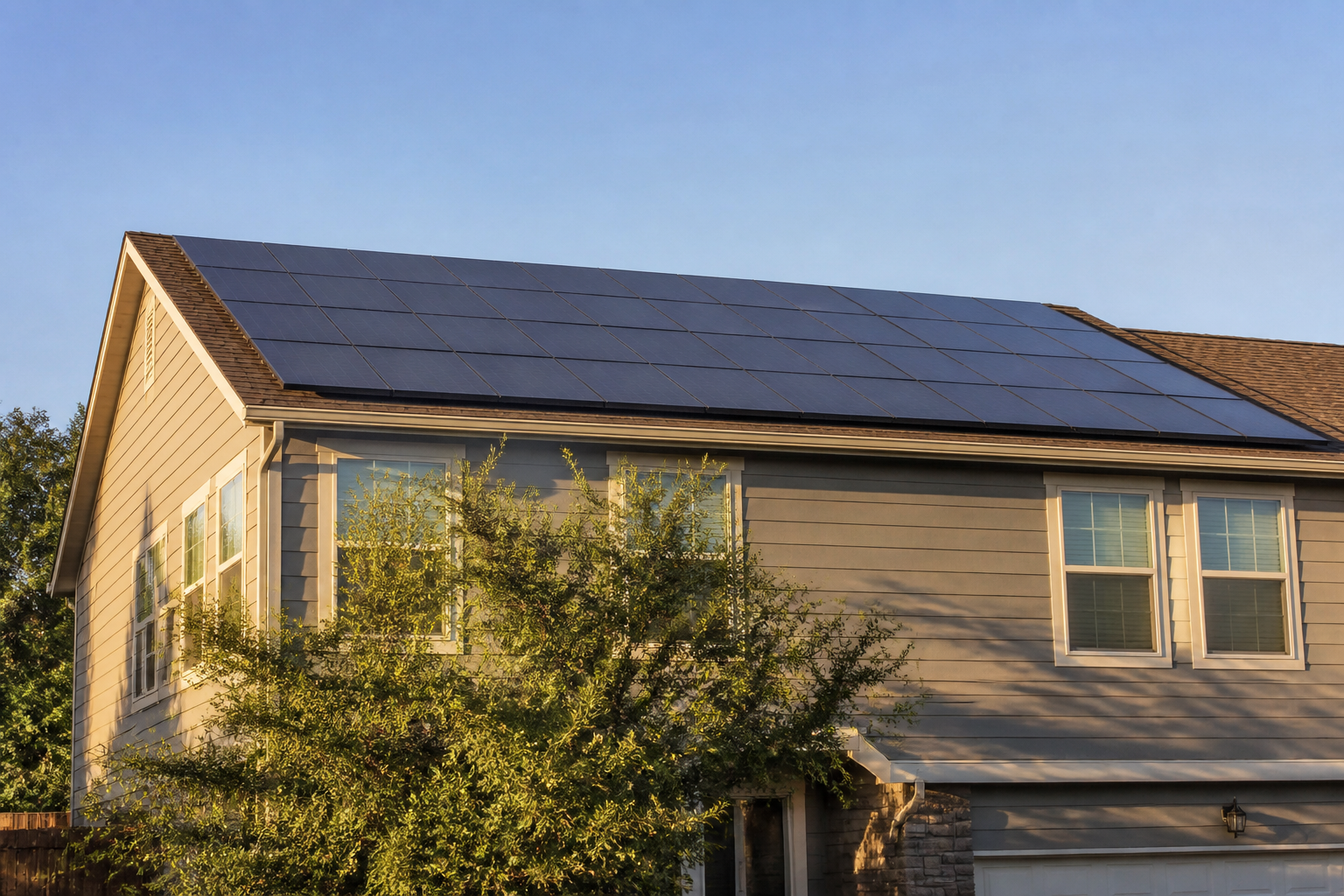
Monocrystalline vs polycrystalline is the first fork in the road when you start comparing solar panels, and the differences are smaller than most sales pages suggest. Both are made from silicon. The split comes down to how that silicon is grown: monocrystalline panels use a single continuous crystal (the Czochralski process), while polycrystalline panels are cast from melted silicon fragments that solidify into many crystals.
That structural difference drives the numbers. Monocrystalline modules typically convert 19, 22% of sunlight into electricity. Polycrystalline sits around 15, 17%. Mono panels are usually black, poly panels blue. Mono costs roughly 10, 20% more per watt, but takes up less roof space for the same output and tends to perform slightly better in low light and high heat.
Why it matters: if your roof is small, mono wins on watts per square metre. If space is cheap and budget is tight, poly still pencils out. Everything else, warranties, degradation, install cost, is broadly similar.
What Is monocrystalline vs polycrystalline?
Monocrystalline and polycrystalline are two ways silicon solar cells are manufactured, and the difference comes down to crystal structure.
Monocrystalline cells are cut from a single silicon crystal grown using the Czochralski process. A seed crystal is dipped into molten silicon and slowly pulled upward, producing one continuous ingot. The result: uniform black cells with rounded corners and efficiencies typically between 19% and 22%, with premium panels pushing past 23%.
Polycrystalline cells (also called multicrystalline) are made by pouring molten silicon into a square mold and letting it cool. Multiple crystals form as it solidifies, which is why these cells have a blue, speckled look. Efficiency usually lands between 15% and 17%.
That efficiency gap matters when roof space is limited. A 400W monocrystalline panel and a 320W polycrystalline panel take up roughly the same area, so if you have 20 square meters to work with, mono gives you more watts per square meter.
Cost is where poly used to win. In 2015, polycrystalline was 15, 20% cheaper. As of 2024, the price gap has narrowed to under 5% because mono manufacturing scaled up. Most residential installations now default to monocrystalline for that reason.
Temperature performance also differs. Mono panels generally have a slightly better temperature coefficient (around -0.35%/°C vs -0.40%/°C for poly), meaning less power loss on hot days.
Scope note: this comparison applies to silicon panels only. Thin-film technologies (CdTe, CIGS) sit in a separate category with different trade-offs.
Key Benefits of monocrystalline vs polycrystalline

The monocrystalline vs polycrystalline debate usually comes down to efficiency, space, and price. Here's what the numbers actually say.
Efficiency. Monocrystalline panels typically convert 20, 22% of sunlight into electricity. Polycrystalline sits at 15, 17%. That gap matters when your roof is small. A 400W mono panel and a 400W poly panel produce the same power on paper, but the mono panel does it using roughly 15% less surface area.
Space efficiency and system size. If you have 30 square metres of usable roof, mono lets you fit more kilowatts up there. For a typical 6 kW residential system, that can mean 15 mono panels versus 18 poly panels. Fewer panels also means fewer mounting brackets, less cabling, and slightly lower install labour.
Performance in low light and heat. Mono panels handle cloudy mornings, shade edges, and hot afternoons better. Their temperature coefficient is usually around -0.35%/°C, compared to -0.40%/°C for poly. On a 40°C roof, that's a real production difference, about 2, 3% more output from mono over the day.
Lifespan and warranties. Both technologies come with 25-year performance warranties, but mono panels often guarantee 87, 92% output at year 25. Poly warranties tend to sit at 80, 83%. Degradation rates are 0.3, 0.5% per year for mono, 0.5, 0.8% for poly.
Where poly still wins: upfront cost. Poly panels run roughly 10, 20% cheaper per watt. If you have unlimited roof space and a tight budget, poly gives you more watts per dollar spent on the panel itself, though that advantage narrows once you factor in racking and labour.
Aesthetics. Mono panels are uniform black. Poly panels have that speckled blue look. Not a technical benefit, but it's why most new residential installs go mono.
Bottom line: mono wins on efficiency, longevity, and space. Poly wins on sticker price.
How monocrystalline vs polycrystalline Works

Both panel types convert sunlight through the photovoltaic effect, but the silicon inside them is grown differently, and that single manufacturing choice drives most of the performance gap.
Step 1: Growing the silicon
Monocrystalline cells start with the Czochralski process. A seed crystal is dipped into molten silicon at around 1,425°C, then slowly pulled and rotated. The result is a single cylindrical ingot where every silicon atom lines up in one continuous crystal lattice.
Polycrystalline (or "multicrystalline") skips that step. Molten silicon is poured into a square mould and left to cool. As it solidifies, it forms many separate crystal grains, you can actually see the shattered-glass pattern on the finished cell.
Step 2: Slicing into wafers
Both ingots are sliced into wafers roughly 160, 180 microns thick. Because mono ingots are round, the corners get trimmed off, which is why mono cells have that distinctive chamfered shape. Poly cells stay fully square.
Step 3: What happens to electrons
Sunlight knocks electrons loose in the silicon. In monocrystalline material, those electrons travel through an uninterrupted lattice, fewer collisions, less energy lost as heat. Efficiency typically lands at 20, 22%.
In polycrystalline material, electrons keep bumping into the boundaries between grains. Each boundary acts like a small roadblock, scattering electrons and recombining some before they reach the circuit. Efficiency sits closer to 15, 17%.
Step 4: Real-world output
For a 400W panel, mono needs about 1.7 m² of roof; poly needs roughly 2.0 m² for the same output. Mono also holds up better in low light and high heat, its temperature coefficient is usually around, 0.35%/°C versus, 0.40%/°C for poly.
The physics is identical. The difference is entirely in how orderly the silicon lattice is when the photons arrive.
Common Questions About monocrystalline vs polycrystalline
Which is more efficient? Monocrystalline wins. Mono panels typically hit 19, 22% efficiency, while poly sits around 15, 17%. On a 400W mono panel versus a 330W poly panel of similar size, that's roughly a 20% output gap per square meter.
Is monocrystalline worth the extra cost? Depends on your roof space. Mono costs about 5, 15% more per watt. If space is tight, pay up. If you have a large roof or ground mount, poly's lower cost per watt can produce the same total kWh for less money.
Do they perform differently in heat? Yes, slightly. Mono panels usually have a temperature coefficient around -0.35%/°C, poly closer to -0.40%/°C. In a 45°C rooftop, mono loses less power. Not huge, but measurable over 25 years.
How long do they last? Both carry 25-year performance warranties, typically guaranteeing 80, 85% output at year 25. Real-world degradation runs 0.5, 0.7% per year for mono, 0.6, 0.8% for poly.
Which looks better? Subjective, but mono panels are uniformly black. Poly has that blue, speckled look. If aesthetics matter, mono is the common pick.
Is polycrystalline being phased out? Largely, yes. As of 2024, mono (especially PERC and TOPCon) makes up over 95% of new residential installations. Poly is still manufactured but shrinking fast.
Which works better in low light? Mono edges out poly on cloudy days and early morning, typically producing 5, 10% more energy under diffuse light, though panel quality varies more than the cell type here.
Conclusion
So, monocrystalline vs polycrystalline: what actually matters?
Mono panels win on efficiency (typically 20, 22%) and take less roof space. Poly panels sit around 15, 17% efficiency but cost roughly 10, 20% less per watt. Both last 25+ years under standard warranties. Temperature coefficients favor mono slightly (-0.35%/°C vs -0.40%/°C), which matters in hot climates.
Key takeaways:
- Roof space tight? Go mono. You'll get more watts per square meter.
- Roof space plentiful and budget tight? Poly still delivers.
- Poly's price advantage has shrunk. In many markets, mono is now within 5% of poly on cost per watt.
- Mono dominates new installations globally, over 95% market share in 2023.
Next step: get three quotes for your specific roof, and ask each installer for the price per watt, panel wattage, and efficiency rating. Compare those three numbers side by side. That's the honest comparison, not the panel type label.
Learn more about Panel types & technology.