
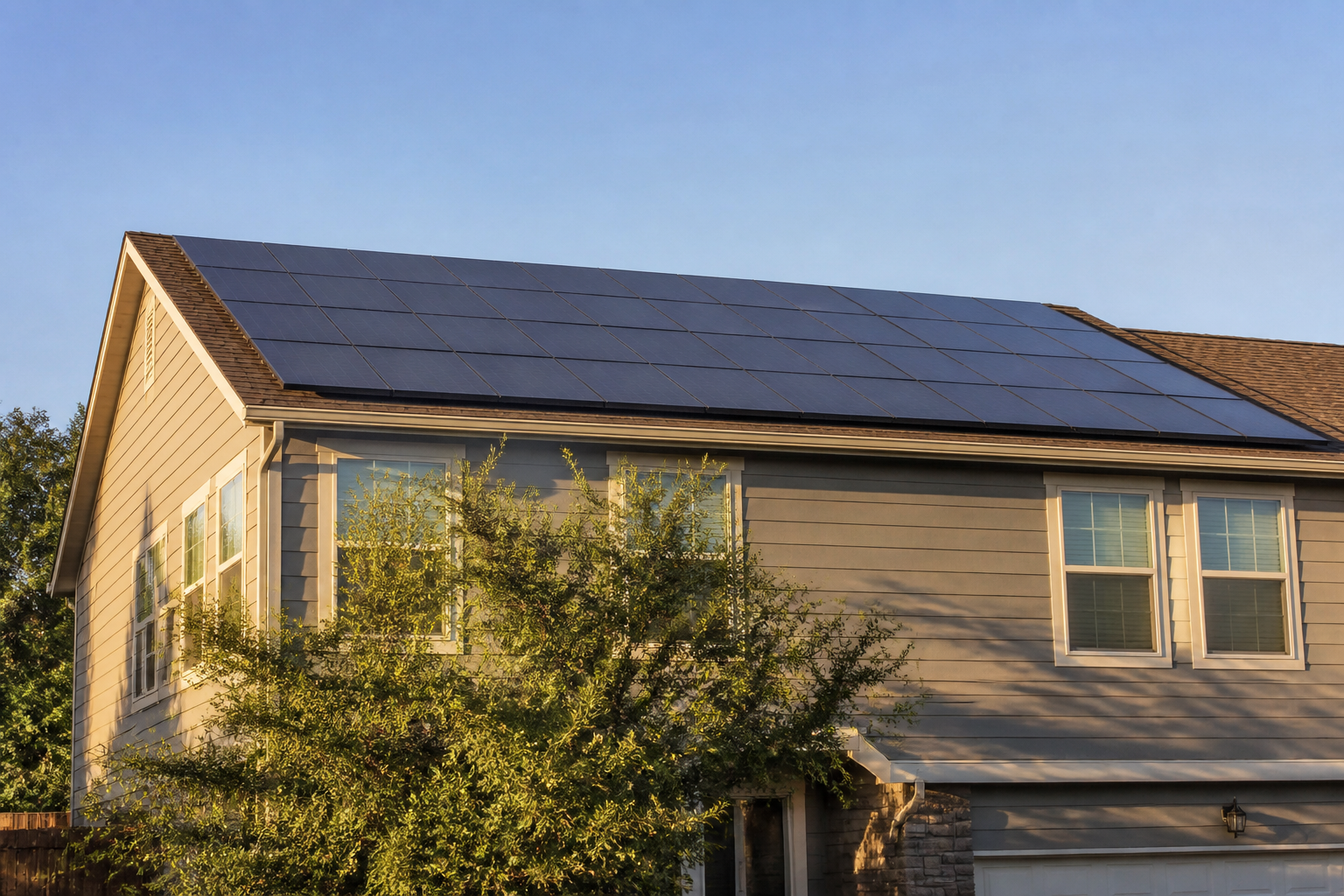
How much do solar panels cost in 2025? For a typical U.S. home, expect to pay between $17,000 and $23,000 for a 10 kW system before the 30% federal tax credit, roughly $12,000 to $16,000 after. That works out to about $2.50 to $3.50 per watt installed, with panels themselves making up only 25 to 30% of the total. Labor, inverters, permits, and installer margins account for the rest.
Prices swing based on where you live, your roof, the equipment you pick, and which company you hire. Quotes for the same house can differ by $10,000 or more. That's why this matters: solar is one of the largest home purchases most people make, and the sticker price hides a lot of moving parts.
The numbers below break down what you're actually paying for, what drives the spread, and how to tell a fair quote from an inflated one.
What Is how much do solar panels cost?
"How much do solar panels cost" is the question most homeowners ask before they ever call an installer, and the honest answer is a range, not a number. As of 2024, a residential solar system in the U.S. runs about $2.75 to $3.50 per watt installed, before incentives. For a typical 8 kW system, that works out to roughly $22,000 to $28,000 gross, or about $15,400 to $19,600 after the 30% federal tax credit.
That figure covers the full package: panels, inverter, racking, wiring, permits, labor, and the installer's margin. The panels themselves are actually the cheap part, usually 25 to 30% of the total. Labor, permitting, sales, and overhead ("soft costs") make up more than half the bill in most states.
Scope matters. A single 400-watt panel wholesales for $150 to $250. A full rooftop system for a 2,000-square-foot home lands in the five-figure range. Commercial and utility-scale projects drop to roughly $1.00 to $1.50 per watt because of economies of scale.
Context shifts the number further. Prices vary by state (California and the Northeast run higher; Arizona and Texas run lower), roof complexity, panel brand, whether you add battery storage (add $10,000 to $20,000), and whether you pay cash, finance, lease, or sign a PPA.
So when someone quotes "the cost of solar," ask three questions: system size in kilowatts, price per watt, and whether that figure is before or after the tax credit. Everything else is marketing.
Key Benefits of how much do solar panels cost

Knowing how much do solar panels cost upfront changes the entire conversation. Instead of reacting to a salesperson's pitch, you walk in with a number in your head, and that number does a lot of work.
You can spot a bad quote in seconds. The national average for a residential system in 2024 sits around $3.00 per watt before incentives, or roughly $18,000 to $25,000 for a 6kW to 8kW system. If a contractor hands you a quote at $4.50 per watt, you know to keep shopping. Three quotes is the minimum. Five is better.
Payback math becomes real, not theoretical. Once you have a firm cost, you can divide by your annual electric bill savings and get a payback period, typically 7 to 12 years in most U.S. states, faster in places with high utility rates like California, Massachusetts, and Hawaii. Panels are warrantied for 25 years, so every year after payback is essentially free electricity.
Incentives stop being vague marketing. The federal residential clean energy credit knocks 30% off your total system cost through 2032. On a $22,000 install, that's $6,600 back at tax time. State rebates, net metering credits, and SREC markets stack on top. You cannot calculate any of this without the base cost.
Financing decisions get sharper. Cash purchase, solar loan, lease, or PPA, each option produces a different lifetime cost. Cash usually wins on total return. Loans can still work if the interest rate is below your utility's annual rate hike. Leases and PPAs almost always deliver the smallest savings. Knowing the sticker price is what lets you compare them honestly.
Resale value gets factored in. Zillow data shows solar homes sell for about 4% more. On a $400,000 house, that's $16,000, often close to the net system cost itself.
How how much do solar panels cost Works

Solar pricing isn't one number, it's a stack of costs layered on top of each other. Here's how the final figure on your quote actually gets built.
Step 1: System size in kilowatts (kW). Installers start by pulling 12 months of your electric bills, then size a system to offset most or all of your usage. The average U.S. home needs 7, 10 kW. Bigger house, bigger system, bigger price.
Step 2: Cost per watt. This is the industry's core unit. As of 2024, residential systems average $2.75, $3.50 per watt installed. Multiply that by system size in watts: an 8 kW system at $3.00/watt = $24,000 gross.
Step 3: Equipment selection. Panel brand matters less than you'd think, most tier-1 panels perform within a few percentage points. Inverters (string vs. microinverters) can swing the price $1,500, $3,000. Batteries add $10,000, $18,000 on top.
Step 4: Soft costs. Roughly 65% of your quote isn't hardware. It's permits, inspections, labor, sales commissions, marketing, and installer margin. This is why the same panels cost double in the U.S. compared to Australia.
Step 5: Roof and site factors. Steep pitch, tile roofs, multiple roof planes, long conduit runs, and old electrical panels all add labor hours. A main panel upgrade alone runs $2,000, $4,000.
Step 6: Incentives get subtracted. The 30% federal tax credit comes off after installation, not upfront. State rebates, SRECs, and net metering credits reduce lifetime cost but rarely lower the sticker price.
Step 7: Financing changes the math. Cash is cheapest. Solar loans add 10, 30% in interest over the term. Leases and PPAs mean $0 down but you don't own the system or claim the tax credit.
Final quote = (watts × $/watt) + adders, incentives. That's the whole formula.
Common Questions About how much do solar panels cost
How much do solar panels cost for an average home in 2024? A typical 6 kW residential system runs $15,000 to $21,000 before incentives, or roughly $2.50 to $3.50 per watt installed. After the 30% federal tax credit, most homeowners pay $10,500 to $14,700.
Do the panels themselves cost a lot, or is it mostly labor? The panels are about 25% of the total. Inverters, racking, wiring, permits, and installer labor make up the rest. Hardware prices have dropped nearly 90% since 2010, but soft costs haven't followed.
What size system will I actually need? Most homes use between 5 kW and 10 kW. Check your last 12 months of electric bills, divide annual kWh by roughly 1,200 to 1,600 (depending on your region's sun hours), and you'll get a rough system size.
How long until it pays for itself? Payback ranges from 7 to 12 years in most states. Higher electricity rates and better sun shorten that. California and the Northeast tend to hit payback faster than the Pacific Northwest.
Is leasing cheaper than buying? Cheaper upfront, more expensive lifetime. A lease or PPA means $0 down but you skip the tax credit and often lock into 20-year escalator clauses.
Do prices vary by state? Significantly. Arizona installs average $2.44/watt; Massachusetts closer to $3.20/watt. Local labor costs, permitting fees, and installer competition drive most of the gap.
What about batteries? Add $10,000 to $18,000 for a single home battery. Not required unless you want backup power or lack net metering.
Conclusion
So, how much do solar panels cost in 2025? For a typical 6kW residential system, expect $15,000 to $21,000 before incentives, or roughly $10,500 to $15,000 after the 30% federal tax credit. Price per watt sits between $2.50 and $3.50 installed, though your quote will swing based on panel brand, inverter type, roof complexity, and your installer's overhead.
Key takeaways:
- System size drives total cost more than any other factor.
- Hardware is only about 25% of the bill. Labor, permits, and soft costs make up the rest.
- Payback periods run 7 to 12 years in most states with decent sun and electricity rates above 15¢/kWh.
- Cash purchases beat leases and PPAs on long-term savings, every time.
Next step: get three itemized quotes from local installers. Compare price per watt, not total price. That single number tells you whether you're being overcharged.
Learn more about Costs & financing.